If God, religion, and spirituality are matters internal and private to a person, what is the role of temples and community worship? This question has been answered rationally and eloquently by many learned scholars and sages. While confessing my inability to paraphrase these, I accept the relevance of temples for some simple reasons. We may not be able to perform elaborate vedic rites at home due to logistics and resource constraints. So, we may satisfy ourselves by participating in these (kumbhabishekam etc.) at temples. Many temples have a history behind them about the origin of the idols – they have been imbued with saannidhyam and chaithanyam. So they radiate benevolent waves which we can receive. But that is not the focus for this blog item.
Today when you go to a temple you need to worry about a hundred things and if God happens to be one of them you are lucky. Recently I went to a temple and had a harrowing experience. I had visited the same temple several times in the 70’s and 80’s and returned with pleasant memorable experiences. I could freely enter, go around, worship; the air used to be cool and the white sand soft on the feet. No one would speak to you a word, no one would offer advise as to what pujas to perform and no one would even volunteer to narrate the sthala puranam to you. You are totally on your own. No hassles of any sort. I used to say that THIS is the definition and benchmark for a temple.
On 29 Mar 2012 my experience was totally different. The place where you keep your bag and footwear has become more bureaucratic. While trying to enter through the main entrance someone orders you to enter through the North gate. You need to walk barefoot through public road with all dirt and stones to reach the North gate. Again, to enter the inner square, you are asked to go to the North side. There the person herds you back to the East side. When you tell him that you were directed to North side by his own colleague he says that for the last 300 years no one has been let in through the North side. At the East side, you are asked to form a single file queue. Suddenly someone comes and tells you to stand three abreast. After you enter, you are disallowed to cast your eyes on any of the other deities – Garudan, Hanumar or Narasimha. After entering the sanctum sanctorum, you thank your stars if you don’t trip and fall on the narrow wooden steps as a result of poking and beating by guards securing the God. God has mysteriously chosen a reincarnation of one of the female demons as His close proximity personal security guard. The display of lathis and batons by temple employees and security agents was a new sight for me as I had not gone to the temple for almost a decade. After all this, did I have darshan of the God? Difficult to answer, an honest answer would be “No”, because I was always concerned about not becoming a victim of the Security Madam’s shoves. It was also a new experience for me to see a priest who is the disciple of a learned scholar acting as tourist guide for a group of wealthy tourists from North India, the scene reminding me of Puri Jagannath temple and the soliciting by pandas.
What has caused this degradation? The only reason I can think of is that the temple has been found to be a treasure house! But, what is the connection between discovering treasure and devotees being subjected to ambiguous and inconsistent set of instructions? Need to control crowds is acceptable but lack of clarity in guiding the crowd is not acceptable. Use of batons to shove the crowd inside the temple is totally unacceptable. Many tourists would not know that they should not prostrate in the monolithic block in front of the deity. Inflicting a whiplash on the bare back of a devotee is cruelty perpetrated right under the nose of and right under the eyes of the Lord!
The younger generation is accused of being too much “this”-worldly and not having space in their minds for religion and spirituality. But, many of them have an open mind and are willing to experience for themselves before accepting or otherwise. Are temples responsible to drive youngsters away from religion?
Friday, March 30, 2012

Monday, June 20, 2011
Wishing away corruption
Wanted to deal with many avatars of corruption, not just the transfer of money called bribe as a quid pro quo for some favor - films and TV serials corrupting the minds of youngsters, unhealthy industrial effluents corrupting the environment, viruses corrupting files and folders on our harddisk and so on. In this post I will confine to the usual connotation. I will describe an effort I started but did not finish.
The immediate mind recall agency when the word corruption is mentioned is the Excise department with the RTO coming a close second. The employees of the department practice corruption as a well documented process because (a) it gives them extra money to indulge in luxuries which they would have had to forego otherwise and (b) if they do not extract money from clients and pay the bosses their share, they are likely to be punished by transfers and suspensions. Both these causes can be handled better if the families of the employees cooperate.
First the families should be familiar with the nature of work their husbands / fathers do and the constraints under which they work. They should be aware or they should be made aware that the luxuries bestowed on them come out of bribes. The family members should know exactly the take-home salary of their bread-winner. They should refuse to accept goods and services beyond the monthly budgeted items.
Secondly, the families should stand by the menfolk when they face transfer / suspension for refusing to be corrupt. The families should form a union of themselves and collectively support their men in staying away from bribes. How many persons the bosses can afford to transfer / suspend? The effect of mass movement should get channelized in this direction.
The influence of the family in eradicating corruption is very strong. Civil society groups should mobilize the families and enlist their support. This will provide better returns for their effort than fighting the provisions of the Lokpal Bill.
Within the department, some clean executives should encourage the families getting together - organize cultural programs by family members, publish a monthly newsletter with contributions from family members and the management.
The immediate mind recall agency when the word corruption is mentioned is the Excise department with the RTO coming a close second. The employees of the department practice corruption as a well documented process because (a) it gives them extra money to indulge in luxuries which they would have had to forego otherwise and (b) if they do not extract money from clients and pay the bosses their share, they are likely to be punished by transfers and suspensions. Both these causes can be handled better if the families of the employees cooperate.
First the families should be familiar with the nature of work their husbands / fathers do and the constraints under which they work. They should be aware or they should be made aware that the luxuries bestowed on them come out of bribes. The family members should know exactly the take-home salary of their bread-winner. They should refuse to accept goods and services beyond the monthly budgeted items.
Secondly, the families should stand by the menfolk when they face transfer / suspension for refusing to be corrupt. The families should form a union of themselves and collectively support their men in staying away from bribes. How many persons the bosses can afford to transfer / suspend? The effect of mass movement should get channelized in this direction.
The influence of the family in eradicating corruption is very strong. Civil society groups should mobilize the families and enlist their support. This will provide better returns for their effort than fighting the provisions of the Lokpal Bill.
Within the department, some clean executives should encourage the families getting together - organize cultural programs by family members, publish a monthly newsletter with contributions from family members and the management.
Tuesday, June 14, 2011
Visionally challenged not visually challenged
We do not need some external element to deceive us. We deceive ourselves very often. This is not a hi-fi philosophy statement. I wrote about the six sigma syndrome. Talking of statistics, consider the following:
Assemble a randomly chosen group of 100 people. Find their average height. Add the tallest person on earth, say, an 8-footer to the group. Recalculate the average height of the 101 people. Do you expect to see a large difference? Hardly.
Find the average net wealth of the same 100 people. Now, add one of the wealthiest people in the world, a Buffett, Mittal, Ambani or even a Bill Gates. Recalculate the average wealth of the group of 101 people. Any difference? Huge.
The statistical principle of finding the average of an augmented group is the same. It is only that the behavioral characteristics of height and wealth are different.
Very often we ignore this and blindly apply techniques and solutions from one context and one era to another context and another era without verifying whether they would be applicable or appropriate.
An educational consultant recommended teacher motivation schemes in an aristocratic school as part of school excellence. It did not take off in another school because the latter’s main problem was drop out of children. Unless this was tackled there was no scope of talking about excellence. He then blamed the poor teachers as not motivatable!!
Assemble a randomly chosen group of 100 people. Find their average height. Add the tallest person on earth, say, an 8-footer to the group. Recalculate the average height of the 101 people. Do you expect to see a large difference? Hardly.
Find the average net wealth of the same 100 people. Now, add one of the wealthiest people in the world, a Buffett, Mittal, Ambani or even a Bill Gates. Recalculate the average wealth of the group of 101 people. Any difference? Huge.
The statistical principle of finding the average of an augmented group is the same. It is only that the behavioral characteristics of height and wealth are different.
Very often we ignore this and blindly apply techniques and solutions from one context and one era to another context and another era without verifying whether they would be applicable or appropriate.
An educational consultant recommended teacher motivation schemes in an aristocratic school as part of school excellence. It did not take off in another school because the latter’s main problem was drop out of children. Unless this was tackled there was no scope of talking about excellence. He then blamed the poor teachers as not motivatable!!
Statistical connery
Conmen (and women) and their tricks come in various shapes and modes. We are familiar with some of them in the domains of politics, religion, and business. How about technology and science? Yes, we have heard of some unscrupulous ones indulging in plagiarism. Here is a case of two great corporations taking the collective scientific mind of the world for a spin. The trick is popularly known as Six Sigma.
Sigma, σ, is a symbol in statistics to denote variation Most phenomena in the world are believed to follow, sooner or later, a pattern of behavior called Normal Distribution. I don’t subscribe to it but that is not the issue for this post. The mean or average value is denoted by the symbol μ (pronounced “mu”). If your process is at 1 σ level that means 32 out of every 100 items produced will be defective (their measured value will lie to the left of μ -1 σ or to the right of μ +1 σ). The curve curves down sharply and not gradually. It is called an exponentially decaying curve. Thus 2 σ will mean 5 out of 100, 3 σ will mean only 0.2 out of 100 defects.
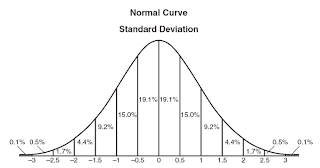
The companies in question claimed that they operate at 6 σ level and they gave a byline that only 3.4 defects will be made in a million opportunities. That is impressive on the face of it. But set against the nature of the normal curve it strikes a discord. 6 σ can not be so lenient as to allow one to make so many mistakes. I painstakingly did all the maths stuff to calculate what 6 σ actually demands. I came up with a figure of 2 over a billion. What an ocean of difference between being allowed to make 3.4 defects per million to 2 defects per billion. Then why are these people making a false claim?
When you say deviation, it is implied that the deviation is with reference to a fixed specification. You are able to say that the train arrived 35 minutes late because there is a scheduled arrival time which is fixed. Suppose the Railways says that the scheduled arrival time can be anywhere between 10.15 AM and 10.55 AM. How do you compute the late arrival of the train when it arrives at 11.00 AM? Railways will claim that the train is only five minutes late because they will conveniently choose the 10.55 option. The great corporations have done exactly the same. They can not hold the process under control beyond a certain capability. So they said that our mean is allowed to make excursions on either side of μ to the extent of 1.5 σ. Where technological improvements show no returns, the strategy is to resort to managerial gimmicks. The corporations would have passed the test of ethics if they had underlined the above assumption along with their 3.4 defects per million tagline.
I can think of only one other instance of similar conjob. That happened 5000 years ago. Yudhistira was made to say that “Aswathama is dead ……………. “ and whisper to the tune of drumbeats “the elephant”.
Sigma, σ, is a symbol in statistics to denote variation Most phenomena in the world are believed to follow, sooner or later, a pattern of behavior called Normal Distribution. I don’t subscribe to it but that is not the issue for this post. The mean or average value is denoted by the symbol μ (pronounced “mu”). If your process is at 1 σ level that means 32 out of every 100 items produced will be defective (their measured value will lie to the left of μ -1 σ or to the right of μ +1 σ). The curve curves down sharply and not gradually. It is called an exponentially decaying curve. Thus 2 σ will mean 5 out of 100, 3 σ will mean only 0.2 out of 100 defects.

The companies in question claimed that they operate at 6 σ level and they gave a byline that only 3.4 defects will be made in a million opportunities. That is impressive on the face of it. But set against the nature of the normal curve it strikes a discord. 6 σ can not be so lenient as to allow one to make so many mistakes. I painstakingly did all the maths stuff to calculate what 6 σ actually demands. I came up with a figure of 2 over a billion. What an ocean of difference between being allowed to make 3.4 defects per million to 2 defects per billion. Then why are these people making a false claim?
When you say deviation, it is implied that the deviation is with reference to a fixed specification. You are able to say that the train arrived 35 minutes late because there is a scheduled arrival time which is fixed. Suppose the Railways says that the scheduled arrival time can be anywhere between 10.15 AM and 10.55 AM. How do you compute the late arrival of the train when it arrives at 11.00 AM? Railways will claim that the train is only five minutes late because they will conveniently choose the 10.55 option. The great corporations have done exactly the same. They can not hold the process under control beyond a certain capability. So they said that our mean is allowed to make excursions on either side of μ to the extent of 1.5 σ. Where technological improvements show no returns, the strategy is to resort to managerial gimmicks. The corporations would have passed the test of ethics if they had underlined the above assumption along with their 3.4 defects per million tagline.
I can think of only one other instance of similar conjob. That happened 5000 years ago. Yudhistira was made to say that “Aswathama is dead ……………. “ and whisper to the tune of drumbeats “the elephant”.
Sunday, May 15, 2011
Fast forward
From yesteryears fast forward to the ITized world. From the 50's to 00's following items moved away from luxury to necessity in a household.
Bicycle, Transistor radio, Watch, Music system, Refrigerator, Two wheeler, Mixie, Grinder, Telephone, Apartment, Microwave oven, Air-conditioner, Independent house, Four wheeler, Desktop PC, Broadband connection, Notebooks/Laptop/Blackberry. Cell phone had direct entry to necessity category without going through the luxury phase.
Similarly in an office, airconditioners, PCs, carpets and LED displays started appearing. The ubiquitous of these is a PC in front of every desk. In the early days the physical size of the PC was directly proportional to one's designation. Today it is inversely proportional.
It is ironical yet true, I feel most disgusted when I see services getting ITized. "Computerized" is a less dignified term. The jump into IT systems has happened without adequate preparation. I go to pay insurance for my vehicle. I am told that the systems are down and they don't know when the systems will come up, that I can go to another branch if I like. I was adamant in staying back and said that I did not mind the delay. The expert arrived a little later and found that the servers were not switched on !! They sport an ISO 9001 certificate for process culture.
I go to a bank to get my passbook updated but either the network is down or the passbook printer is down. If they have 4 passbook printers why can't they have a fifth as a cold standby?
I remember the early years when Indian Airlines used to do the reservation on the system and write out the ticket manually because printing the ticket was deferred to Phase II of ITization !!
Railways did better except that due to an error in the RAC processing logic, the family members were split into different bogies.
The Water Authority will ask for the consumer number and all details like name, address etc. every time and enter. Nobody knew that with the consumer number as the "key" the other details could be retrieved from the disk and printed on the receipt. When I tried to tell them so, they would not listen because the World Bank appointed experts had not told them to operate in this way !! The only change the computer brought about for them was replacement of the pen with the keyboard and the messy carbon sheet interspersed receipt writing with the printer.
To this day I have not figured out how to see my BSNL bill details through the Net.
Can someone help?
The most painful tyranny inflicted on the consumer is the ultimate in modern technology - the 1-800 number syndrome for lodging customer complaints.
Press 1 for Hindi, 2 for English......
Press 1 for queries, 2 for sale, 3 for complaints...........
Press 1 for warranty, 2 for AMC and 3 for ...........
....
....
Sorry, we are available only from 9 to 5 Monday thru Friday.
In the absence of any other way to establish communication, you wait till Monday, register the complaint, wait till Friday because nothing had happened, get back to "1-800, Press 1 for ...." drill and you are told that your complaint has been attended to. No way to convince the operator because the system says that the case is closed and systems don't lie. If you want you can register a fresh complaint. Again no one has turned up, but there is a call from the agency asking for the feedback on the service. When I said that there has been no service so far, the canned reply comes out "Thank you for your valuable feedback madam" ( I am used to people using "Sir" in place of "Madam", this is the first instance I heard "Madam" being used in place of "Sir")
The canned reply phrase tempts me to document an experience on Indian Airlines. Avro flight from Mumbai to Ahmedabad (ETD 6 PM) started late at 7 PM and after a turbulent flight neared the destination only to be told that the runway lights are not functioning and that we should go back to Mumbai. Again it started at 1045 PM and halfway to Ahmedabad had to return because of very bad weather. When the weather cleared, the duty timing of the crew was over and we had to await a fresh crew. Finally we landed at Ahmedabad at 7 AM , late by 12 hours and spending allthe time inside the aircraft or on the departure lounge. The whole aircraft exploded with laughter and booing when the steward repeated the canned announcement "Aasha hai ki aapki yatra sukhad rahi" .,... " Hope you had a pleasant flight". I could understand because in public sector, improvisation is frowned upon".
Bicycle, Transistor radio, Watch, Music system, Refrigerator, Two wheeler, Mixie, Grinder, Telephone, Apartment, Microwave oven, Air-conditioner, Independent house, Four wheeler, Desktop PC, Broadband connection, Notebooks/Laptop/Blackberry. Cell phone had direct entry to necessity category without going through the luxury phase.
Similarly in an office, airconditioners, PCs, carpets and LED displays started appearing. The ubiquitous of these is a PC in front of every desk. In the early days the physical size of the PC was directly proportional to one's designation. Today it is inversely proportional.
It is ironical yet true, I feel most disgusted when I see services getting ITized. "Computerized" is a less dignified term. The jump into IT systems has happened without adequate preparation. I go to pay insurance for my vehicle. I am told that the systems are down and they don't know when the systems will come up, that I can go to another branch if I like. I was adamant in staying back and said that I did not mind the delay. The expert arrived a little later and found that the servers were not switched on !! They sport an ISO 9001 certificate for process culture.
I go to a bank to get my passbook updated but either the network is down or the passbook printer is down. If they have 4 passbook printers why can't they have a fifth as a cold standby?
I remember the early years when Indian Airlines used to do the reservation on the system and write out the ticket manually because printing the ticket was deferred to Phase II of ITization !!
Railways did better except that due to an error in the RAC processing logic, the family members were split into different bogies.
The Water Authority will ask for the consumer number and all details like name, address etc. every time and enter. Nobody knew that with the consumer number as the "key" the other details could be retrieved from the disk and printed on the receipt. When I tried to tell them so, they would not listen because the World Bank appointed experts had not told them to operate in this way !! The only change the computer brought about for them was replacement of the pen with the keyboard and the messy carbon sheet interspersed receipt writing with the printer.
To this day I have not figured out how to see my BSNL bill details through the Net.
Can someone help?
The most painful tyranny inflicted on the consumer is the ultimate in modern technology - the 1-800 number syndrome for lodging customer complaints.
Press 1 for Hindi, 2 for English......
Press 1 for queries, 2 for sale, 3 for complaints...........
Press 1 for warranty, 2 for AMC and 3 for ...........
....
....
Sorry, we are available only from 9 to 5 Monday thru Friday.
In the absence of any other way to establish communication, you wait till Monday, register the complaint, wait till Friday because nothing had happened, get back to "1-800, Press 1 for ...." drill and you are told that your complaint has been attended to. No way to convince the operator because the system says that the case is closed and systems don't lie. If you want you can register a fresh complaint. Again no one has turned up, but there is a call from the agency asking for the feedback on the service. When I said that there has been no service so far, the canned reply comes out "Thank you for your valuable feedback madam" ( I am used to people using "Sir" in place of "Madam", this is the first instance I heard "Madam" being used in place of "Sir")
The canned reply phrase tempts me to document an experience on Indian Airlines. Avro flight from Mumbai to Ahmedabad (ETD 6 PM) started late at 7 PM and after a turbulent flight neared the destination only to be told that the runway lights are not functioning and that we should go back to Mumbai. Again it started at 1045 PM and halfway to Ahmedabad had to return because of very bad weather. When the weather cleared, the duty timing of the crew was over and we had to await a fresh crew. Finally we landed at Ahmedabad at 7 AM , late by 12 hours and spending allthe time inside the aircraft or on the departure lounge. The whole aircraft exploded with laughter and booing when the steward repeated the canned announcement "Aasha hai ki aapki yatra sukhad rahi" .,... " Hope you had a pleasant flight". I could understand because in public sector, improvisation is frowned upon".
Wednesday, April 13, 2011
yesteryear musings (10) medicare
Every family had its own doctor - there were no 5* hospitals vying with 5* hotels for ambience. The doctor's room measured 10 ft x 10 ft. He had a thermometer, stethescope, a wooden hammer and occasionaly the BP instrument. He used to keep one thumb on the abdomen and strike over it with the other thumb. That was the acoustic penetration test to see if the intestine, liver and kidneys were in tact. He used to strike the knee with the wooden hammer and sense the reaction of the patient.
The dispensation was always packets of some powder and a mixture (yellowish brown or rose in color). My most favorite treatment at the doctor's was the "throat touch". When you had sore throat, the throat was painted with a pinkish liquid - the liquid tasted sour and soothing. Alas the liquid has disappeared - was it called the Mandel solution or something sounding similar.
The dispensation was always packets of some powder and a mixture (yellowish brown or rose in color). My most favorite treatment at the doctor's was the "throat touch". When you had sore throat, the throat was painted with a pinkish liquid - the liquid tasted sour and soothing. Alas the liquid has disappeared - was it called the Mandel solution or something sounding similar.
Wednesday, March 30, 2011
yesteryear musings (9) - lifestyle
Practice of madi has become extinct with nuclear families and pigeon-hole apartments replacing joint families and spacious houses. Those who practiced madi will not tolerate anybody else touching them or even coming near them. The non-madi section of the household was called vizhuppu. The madi people themselves wake up in the morning in vizhuppu state. They attain madi state after a bath and wearing madi clothes untouched by vizhuppu people. Can you spot a logical contradiction there? The person trying to enter madi state is vizhuppu, how can he or she handle madi clothes. This is where Physics and ingenuity come into play. Wood is a non-conductor of vizhuppu. Hence the cloth is picked up from the clothesline using one end of a long wooden stick aptly called madikkuchi. The cloth itself retains madiness because it was left to dry by the madi person the previous day and hoisted up the clothesline using the same wooden stick. The clothesline was reserved exclusively for drying madi clothes. It was installed high on the ceiling so that there was no chance of the clothes brushing any passer-by. Other than wood, exceptions to the madi rule were brand new clothes (kodi thuni), silk and rubber. If I remember right, plastic too was conferred the honor in later times. I am not sure about silver though. The madi state was a prerequisite for offering prayers and for cooking. The madi status of a person will get nullified after the person has had his/her lunch.
The madi culture had its associated life style practices too. One was the food routine. You are expected to have lunch around 10.30 AM, tiffin at 4.00 PM and dinner at 8.00 PM. You are branded as a low-caste person if you prefer breakfast (“tiffin”) at 8.30 AM and lunch at 1.00 PM. Due to exigencies of modern work timings, this has slowly but reluctantly come to be accepted. In those days, the menfolk used to leave for office at 10.45 AM and return home for tiffin at 4.00 PM. Another cultural requirement to retain your high caste status was that the lunch should necessarily conclude with rice and curd / buttermilk. Anyone skipping the moru sadam routine was branded as a low caste person.
The madi culture had its associated life style practices too. One was the food routine. You are expected to have lunch around 10.30 AM, tiffin at 4.00 PM and dinner at 8.00 PM. You are branded as a low-caste person if you prefer breakfast (“tiffin”) at 8.30 AM and lunch at 1.00 PM. Due to exigencies of modern work timings, this has slowly but reluctantly come to be accepted. In those days, the menfolk used to leave for office at 10.45 AM and return home for tiffin at 4.00 PM. Another cultural requirement to retain your high caste status was that the lunch should necessarily conclude with rice and curd / buttermilk. Anyone skipping the moru sadam routine was branded as a low caste person.
Subscribe to:
Posts (Atom)